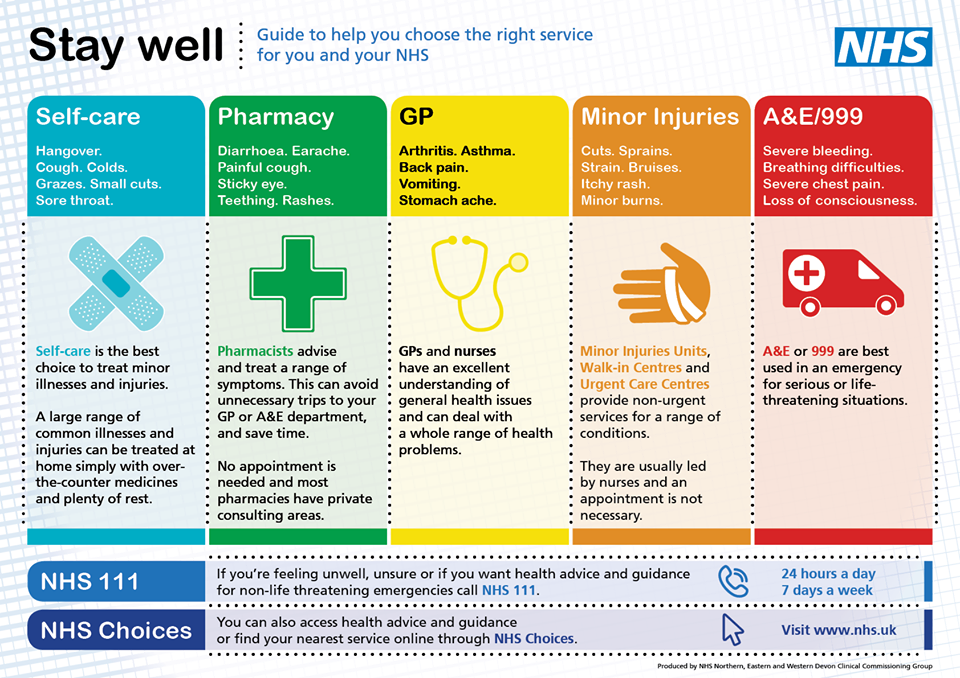
The following poster produced by the NHS will help you make the best choice if you think you need medical attention:
In the event of a serious medical emergency you should immediately seek help from someone close by and call the Emergency Services by dialing 999 or 911 or 112 (these numbers can work on a mobile even if you don’t have a signal). If a Defib or a Bleed Control Kit is needed the Emergency Operator will give you the code for you to unlock the Defib Cabinet and get one.
To help you in a medical emergency you should identify a number of ICE (In Case of Emergency) telephone numbers on your phone, list your key personal and medical information in a Message in a Bottle in your fridge, and ask a friend or neighbour to be your Personal Buddy who you can call in an emergency to help you until the professionals arrive.
The following is offered as guidance only,can not and should not replace proper qualified medical advice and attention.
ICE & Message in a Bottle
ICE (In Case of Emergency)
To help you in an emergency you should identify several important personal numbers (eg family, close friends, neighbours) as ICE numbers on your mobile phone, or leave them by your phone at home. This will enable the Emergency Services quickly to find the best person to contact if you are injured, ill or incapacitated, as they are readily accessible. If your phone is password protected you can put a sticker on your phone listing your ICE numbers, or install an App to allow someone to access your emergency contacts even when your phone is locked. You can identify or prioritise several ICE numbers by entering them as “ICE-person’s name” or as “ICE-1”, “ICE-2”, “ICE-3” etc. You can also keep your ICE numbers in your wallet or purse.
Message in a Bottle
To help you in a medical emergency at home, you should list key personal and medical information about yourself and your family (eg medical conditions, allergies, medications) and place them in a small plastic bottle marked with a green cross on the top right hand corner of the shelf in your fridge door. By putting a small green cross sticker on the inside of your house door, the Emergency Services will know that you have a Message in a Bottle in your fridge and can immediately obtain potentially life saving medical information about the patient, especially if they are upset, confused or unconscious. The Message in a Bottle scheme was pioneered by Lions Clubs International (http://lionsclubs.co/Public/lions-message-in-a-bottle/) , and Bottles can be obtained free of charge, including from Doctor’s Surgeries, Pharmacies as well as the local Lions.
Heart Attack & Stroke
Heart Attack
In the event of a suspected heart attack you may, although not necessarily, experience or notice one or several of the following symptoms:
- Crushing pain in the chest
- Pain running down one or both arms, usually the left
- Pain in the neck, shoulders, back or abdomen
- Profuse sweating
- Shortness of breath or laboured breathing
- Tension in the jaw and aching teeth
- Feeling sick or vomiting
- Confusion or dizziness
- Overwhelming feeling of anxiety
If affected by or see any of these symptoms you should call 999 immediately
Stroke
In the event of a stroke you may, although not necessarily, experience or notice one or several of the following symptoms.
These can be remembered with the word FAST: Face – Arms – Speech – Time
- Face– the face may have dropped on one side, the person may not be able to smile or their mouth or eye may have drooped
- Arms– the person may not be able to lift both arms and keep them there because of arm weakness or numbness in one arm
- Speech– their speech may be slurred or garbled, or the person may not be able to talk at all despite appearing to be awake
- Time– it is time to call 999 immediately if you notice any of these signs or symptoms
Other symptoms and signs may include:
- paralysis of one side of the body
- sudden loss or blurring of vision
- dizziness
- confusion
- difficulty understanding what others are saying
- problems with balance and co-ordination
- difficulty swallowing
- a sudden and very severe headache resulting in a blinding pain unlike anything experienced before
- loss of consciousness
If affected by or see any of these symptoms you should call 999 immediately
Dealing with a Cardiac Arrest
SIMPLE STEPS THAT COULD SAVE YOUR LOVED ONE’S LIFE
Just follow DRs ABC as quickly as possible:
1 Look for DANGER – to yourself and the casualty (fire, electricity, gas, chemicals, machinery)
2 Check RESPONSE – is casualty alert, confused, unresponsive?
You can check if the person is responsive by speaking to them, gently shaking them & tapping their collar bones
3 SHOUT for HELP – if casualty is unconscious call your DEFIB BUDDY & ring 999
4 Open AIRWAY – if not responding
Place one hand on the casualty’s forehead & two fingers under their chin
Gently tilt their head back & lift the chin. Check nothing in the mouth
5 Check BREATHING – look, listen and feel
Maintain the head tilt & chin lift
Look for chest movement, listen for sounds of normal breathing, can you feel their breath on your cheek
6 Give CPR (chest compressions) if not breathing – get casualty onto floor or hard surface, not onto bed
Kneel down beside casualty level with their chest
Place heel of your hand towards the end of their breastbone, in the centre of their chest
Place heel of your other hand on top of the first & interlock your fingers
Lean over casualty, with your arms straight & press down vertically on the breastbone by 5-6cm (2-2½in), keeping your fingers off the ribs
Release pressure without removing your hands from their chest
Repeat 30 times at a rate of about twice a second (120 per min), the speed of singing the song ‘Staying Alive’ or ‘Nellie the Elephant’
If you hear ribs cracking/breaking do not be alarmed – this is not unusual as it just means your CPR is effective. Your priority is to keep your casualty alive – broken bones can be mended later
How to give a rescue breath
Ensure the casualty’s airway is open
Pinch their nose firmly closed, take a deep breath and seal your lips around their mouth
Blow into the mouth until the chest rises. Remove your mouth and allow the chest to fall
Repeat once more
Carry on giving 30 chest compressions followed by two rescue breaths for as long as you can, or until help arrives
If the casualty starts breathing normally again, stop CPR and put them on their left side in the recovery position
IMPORTANT: Doing this can and does save lives
Defibrillators
Life Saving Defibrillators in the Parish
We have three Community Access AEDs (Automated External Defibrillators) in the Parish. This is great news as the swift use of a Defibrillator in a cardiac emergency along with performing CPR (Cardio Pulmonary Resuscitation) on the casualty until the Ambulance arrives, really does save lives. For those of you living in the South-East of the Parish, there is another Defibrillator outside the Village Hall in Mount.
Each of our Defib Cabinets also has an Emergency Bleed Control Kit comprising gloves, foil blankets, trauma shears, tourniquets and dressings, plus simple instructions, to be used to control and provide initial treatment of major injuries until the Emergency Services arrive. These Kits are maintained alongside our Defibs by Duchy Defibrillators and have been supplied free of charge by FLEET (Front Line Emergency Equipment Trust) from Bleed Control UK. They are accessed if needed in the same way as a Defib by phoning 999 and asking for the access code to open the Cabinet.
Our two newest Defibrillators, courtesy of generous funding from the Callybarrett Wind Turbine Community Fund and the National Lottery, have been installed by FLEET/Duchy Defibrillators on the outside wall of the Chapel in Millpool and beside the Common in Littledowns. The cabinet housing the original Defibrillator in the old telephone box opposite the School in Cardinham has been upgraded. Thanks must also go to the people who are “hosting” the new installations, as well as to those volunteers who respond and help in an emergency.
Although AEDs are easy and safe to use, and will automatically “talk you through” exactly what to do in an emergency, it’s very useful if you’re able to attend a short training session to learn first hand how to use the equipment and perform CPR in a relaxed atmosphere before you might need to act in earnest. We will be offering sessions over the coming months in Cardinham and Millpool, and are also looking for people who would like to host small groups of friends and neighbours in their own homes for training. In this way we can get the message spread widely across the Parish, so please let us know if you would like to host a session.
In the meantime, please make sure you know where the closest Defibrillator to you is located, and ideally find yourself a personal “Defib Buddy” who you can ring in an emergency and ask to collect the Defibrillator for you and help administer CPR with you until Paramedics and the Ambulance arrive. You can also offer to be a “Buddy” for your friends.
Your first action in any emergency of course is to ring 999 to request an Ambulance. All of the information you need on what to do in a cardiac emergency and how to give CPR is on the Red Card that the Parish Council sent out to all households last year – the only change is that you now have to ask the Ambulance Control Phone Operator to give you the key code so that you can unlock the cabinet to get the Defibrillator. If your Card has been mislaid you can get a replacement from me. Full details are also on our website www.cardinhamparish.net
If you feel you can offer to help, we’re looking for volunteers who could monitor our AED cabinets every so often or join our small Support Network of people who respond to emergency alerts, if they are available, and go to where the Defibrillator has been taken to assist before the Paramedics arrive. In the longer term it would be fantastic if the Parish could develop its own First Responder Network of trained people able to administer a range of First Aid to casualties. If you have any thoughts on this, please let us know.
If you want to know anything more or think you can help, please let me know by emailing cardinhameditor@cardinhamparish.net or by contacting the Parish Council directly. Many thanks in anticipation!
Choking
A person choking on something can be quite common but also be highly dangerous. So here are three simple tips to help you deal with the situation in an emergency. If a child can walk, then treat them as an adult:
- Cough. Get the person to try to cough it up, but if that doesn’t work…
- Slap. Get the person to lean forward, support them with one hand in the centre of their chest and give them a hard slap right in the centre of their back with the heel of your hand. You need to be firm – you should really feel it on your hand. If the first slap doesn’t dislodge it, then slap them again. Each time, check whether you have managed to clear the obstruction, but if not give up to 5 firm backslaps. If this doesn’t work, then don’t panic…
- Squeeze (heimlich manoeauvre). Grasp the person round their middle from behind. Put your thumb into the palm of your hand, and close your fingers round it to make a fist. Then with the thumb side of your fist, point it into their abdomen, halfway between their belly button and the bottom of their breast bone. Put your other hand on top, and squeeze tightly, inwards and upwards. Check to see if this has dislodged the object. If not, do it again. Do up to 5 of these abdominal thrusts, and then go back to the 5 back slaps.
- Get someone to call for an ambulance if three cycles of slaps and abdominal thrusts don’t work. Even if your thrusts have been successful, the person should always be checked out in case there is any internal damage. But don’t be afraid to try these techniques – in an emergency, it is trying that counts.
- If it is a young baby that is choking, too young to walk, then just adapt the techniques slightly:
- Slap. Lay the baby face down along one forearm and slap them firmly in the centre of the back with the other hand. Again, the slap should be sharp and hard. As before, do up to 5 of these, but if they don’t work, try…
- Squeeze. Lay the baby face up on your forearm, and using two fingers poke hard downwards and slightly towards the head on their breastbone, in the centre of their chest just below their nipples. Again, do up to 5 of these, and then, if necessary, turn the baby over and try the back slaps again.
- As with an adult, get someone to call an ambulance if the initial back slaps and thrusts haven’t worked, and ensure that the baby is checked for any problems if you’ve had to do an abdominal thrust.
Sepsis
Sepsis (previously known as blood poisoning or septicaemia) is a very serious medical emergency that can quickly lead to death. In its early stages, sepsis is often difficult to distinguish from ‘flu, especially in young children. So it’s better to be safe than sorry, and seek urgent medical attention if you suspect sepsis.
If you notice any of these symptoms after a recent fever, call 999 immediately and say you suspect sepsis:
• Slurred speech or confusion
• Extreme shivering or muscle pain
• Passing no urine (in 18 hours or a day)
• Severe breathlessness
• Extreme feeling of something being wrong
• Mottled, bluish or very pale skin colour
Remember if it is sepsis, getting treatment even one hour earlier might make the difference between life and death.
Sepsis is the body’s reaction to an infection that causes it to attack its own organs and tissues. If not spotted and treated quickly, sepsis can rapidly result in shock, multiple organ failure and death. The risk of death from sepsis can be five times greater than from a heart attack or stroke. However if caught early, the outlook is good for the vast majority of patients. Consequently it is very important not to delay seeking medical attention.
Further information on sepsis can be obtained from The UK Sepsis Trust or NHS Choices
Meningitis
Meningitis is an infection of the protective membranes (meninges) that surround the brain and the spinal cord. It is a serious disease requiring urgent medical attention, and there are a number of different strains and causes:
Viral meningitis is the most common form of the disease but it’s also the least serious and, although it can make people very unwell, it’s rarely life-threatening.
Bacterial meningitis, however, is very dangerous and can kill if it isn’t identified and treated quickly. It can be caused by a number of different bacteria, including several types of meningococcal bacteria which cause the strains known as Men A, B, C, W, X, Y and Z. These bacteria are also types that can cause sepsis (blood poisoning), and so sepsis can follow an initial bacterial meningitis infection as it spreads around the body.
Meningitis can affect anyone, though it is most common in babies, children and teenagers, as well as the elderly and those with weakened immune systems.
The viruses and bacteria that cause meningitis are spread from person to person through close physical contact like coughing, sneezing, kissing or sharing utensils and cutlery.
Healthy people can carry the bacteria in their nose and throat without actually getting the disease, and in fact most ‘carriers’ don’t actually get ill. Unfortunately ‘carriers’ can spread the bacteria to those who are more vulnerable to infection.
Symptoms
Although there are different types of meningitis, the most common symptoms to look out for include:
- Fever
- Vomiting
- Severe headache
- Dislike of bright lights
- Stiff neck
- Confusion
- Sleepy or unresponsive
- Seizures
- Rash
Most people are aware of the classic rash associated with meningitis that doesn’t disappear when you press a glass firmly against it. However this is a late sign and an indication that meningitis has led to sepsis. So if you’re worried about meningitis don’t wait until a rash appears to seek help.
The rash typically starts off as small red pinpricks but these turn into red or purple coloured blotches as it spreads all over the body. It can be difficult to spot on darker skin so keep an eye on the palms, the soles of the feet or other paler areas.
If you see this rash you should seek urgent medical attention – it is a sign that sepsis has started and it can quickly be life-threatening.
If you spot any of the other signs, you should call for medical help and describe them carefully, saying that you suspect meningitis or sepsis. If you have been reassured by a professional once but the symptoms worsen, call again.
The symptoms of meningitis can appear slightly different in babies and could include:
- Refusing to feed
- A bulging soft spot on the head
- Unresponsive
- Agitated
- Having a stiff body
If you spot these symptoms you should seek medical advice immediately – and remember that not all of these signs will always be present.
Vaccination
There are a number of vaccinations available on the NHS that can protect against meningitis:
Meningitis B
Men B is the most common cause of bacterial meningitis in the UK and peaks in babies around 5-6 months of age. The Men B vaccination is currently recommended by the NHS for babies at 8 weeks, 16 weeks and one year.
Meningitis C
Until July 2016, babies were offered a Men C vaccination at 12 weeks, but this programme has been so successful that the vaccination is no longer required and has been discontinued. All children are still offered a Hib/Men C vaccination at age 1 and the Men ACWY vaccination is offered to teenagers.
Meningitis ACWY
In recent years a deadly new strain of Men W has emerged, causing a spike of cases, particularly amongst young people. This new vaccine protects against Men W and three other causes of meningitis and sepsis, and is currently being rolled out to target teenagers and students. In the future this vaccine will be offered to 14 year olds as part of the routine schools vaccination programme.
Medical Training
After several training sessions over recent years we now have a small but keen band of local residents who have learned valuable life saving skills on dealing with medical emergencies including heart attacks, major bleeds, choking and fractures, as well as the use of our Defibrillators and how to give CPR.
However all residents are strongly encouraged to attend future training sessions so that the knowledge on what to do in an emergency can be spread widely throughout our local community for the benefit of us all. Responding immediately to a medical emergency with simple first aid before the ambulance or paramedic arrives, has been shown to increase the casualty’s chances of recovery significantly. Hence sharing first aid tips and arranging emergency medical training sessions to help people feel more able and confident to respond when the unfortunate happens is seen as an important community function.
The British Heart Foundation also has a free online 15 minute training course called RevivR on its website that teaches you how to give effective CPR and use a Defibrillator. All you need is a cushion and a mobile phone or tablet to complete the course.
Samaritans

If you need help – Please talk to us
Samaritans are available 24 hrs a day and can be contacted on a FreeCall number 116 123. You can visit our branch anytime between 0900 and 2100 each day. You don’t have to be desperate to call us.
Remember – we’re always here, we offer a safe place to talk. As volunteers we’re ordinary people who keep what you say between us. You can be yourself whoever you are, however you feel, whatever life’s done to you.
Website: www.samaritans.org/cornwall
Twitter: @cornwallsamari1
We can make a difference – Please volunteer with us
The phone rings three times. A volunteer picks it up. “Samaritans – can I help you?” And so starts a conversation that may last a few minutes or an hour or so.
Volunteers at Samaritans Cornwall, last year received over 50,000 contacts. By phone, email, texts and face to face. Gill Pipkin, the branch director said “We listen, support, we don’t hurry a caller, neither do we tell them what they must do. All in a non-judgmental way, offering absolute confidentiality.”
Volunteers are at the heart of Samaritans and are welcomed from all walks of life and of all ages. Full training is given and there is incredible support at the branch. Gill also mentioned that – “We not only welcome listening volunteers but also people to help support the branch by undertaking a wide range of other activities. Our Outreach team does regular shifts at A&E, Camborne Food Bank and public events. We also need support volunteers to help with administrative work, fundraising IT, publicity or helping us look after our building. To touch another person’s life when it really matters, by helping them directly, or by keeping our branches running, is a rare gift.”
If you would like to know more please:
Call 01872 222 321